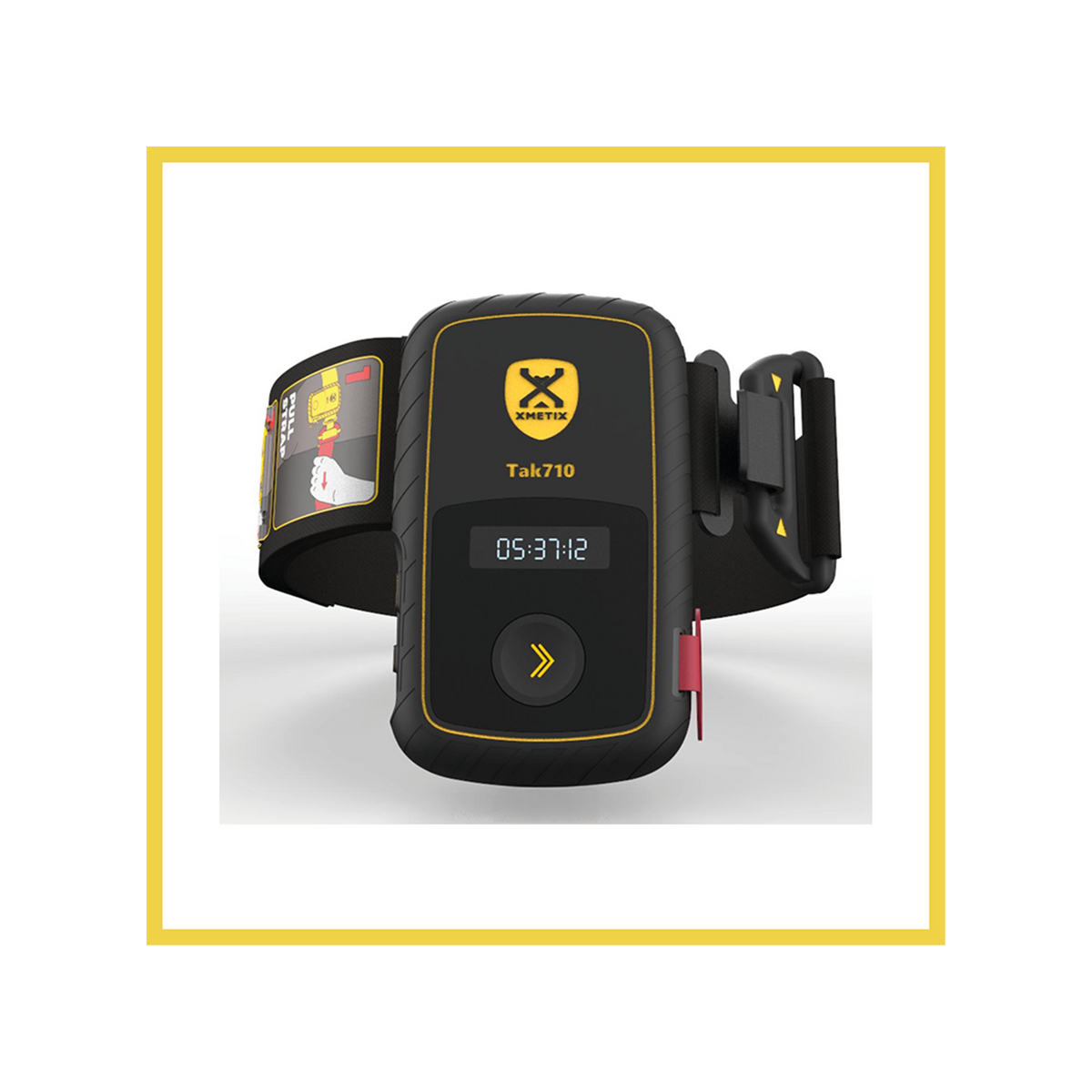
An automatic tourniquet that outperforms existing solutions.
Stops severe limb bleeding in less than 34 seconds. One button press — no medical knowledge and no manual tightening.
- <34 s
- to stop bleeding
- 1 button
- operation without medical training
- IDF
- combat-proven
- ✔ CE certificate
- ✔ FDA listed
- ✔ MIL-STD-810G standard
- ✔ Thousands of units in the Israel Defense Forces
- Featured on Defence24
For civilians
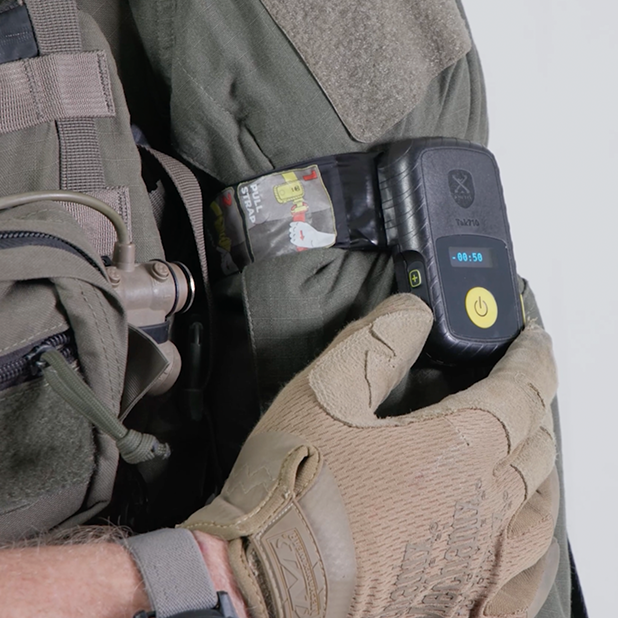
You can apply TAK710 yourself, even one-handed. Operation does not require medical knowledge — just a few simple steps.
Road accidents
Car and motorcycle collisions are one of the most common causes of serious limb injuries requiring immediate bleeding control.
Physical work
Agriculture, forestry, construction, workshops: contact with machinery, saws and sharp tools carries a real risk of deep wounds.
Shooting, hunting, extreme sports
Environments where medical help may be delayed.
Home and family first aid
Accidents involving knives, glass, power tools.
For emergency services and professionals
Professional groups where automating pressure directly affects operational outcomes: the military and security forces, rescue teams, and medical personnel working in extreme conditions.
Military, WOT, volunteers
In modern operations, where the scale of limb injuries is rising, the speed and repeatability of equipment use directly affects survival.
Police, fire service, volunteer fire brigades, emergency medical services
Automatic pressure reduces human error under stress and shortens the time to stop bleeding.
Medical personnel and humanitarian organisations
Operating close to conflict zones — a repeatable effect regardless of the operator's training level matters in mass-casualty incidents.
Why TAK710?
Classic tactical tourniquets require strength, manual dexterity and training — you have to pull the strap correctly, turn the windlass, and secure it at the right angle. Under stress, or when the injury affects the dominant hand, correct application of a classic tourniquet can be difficult even for trained people — and often impossible for a random bystander.
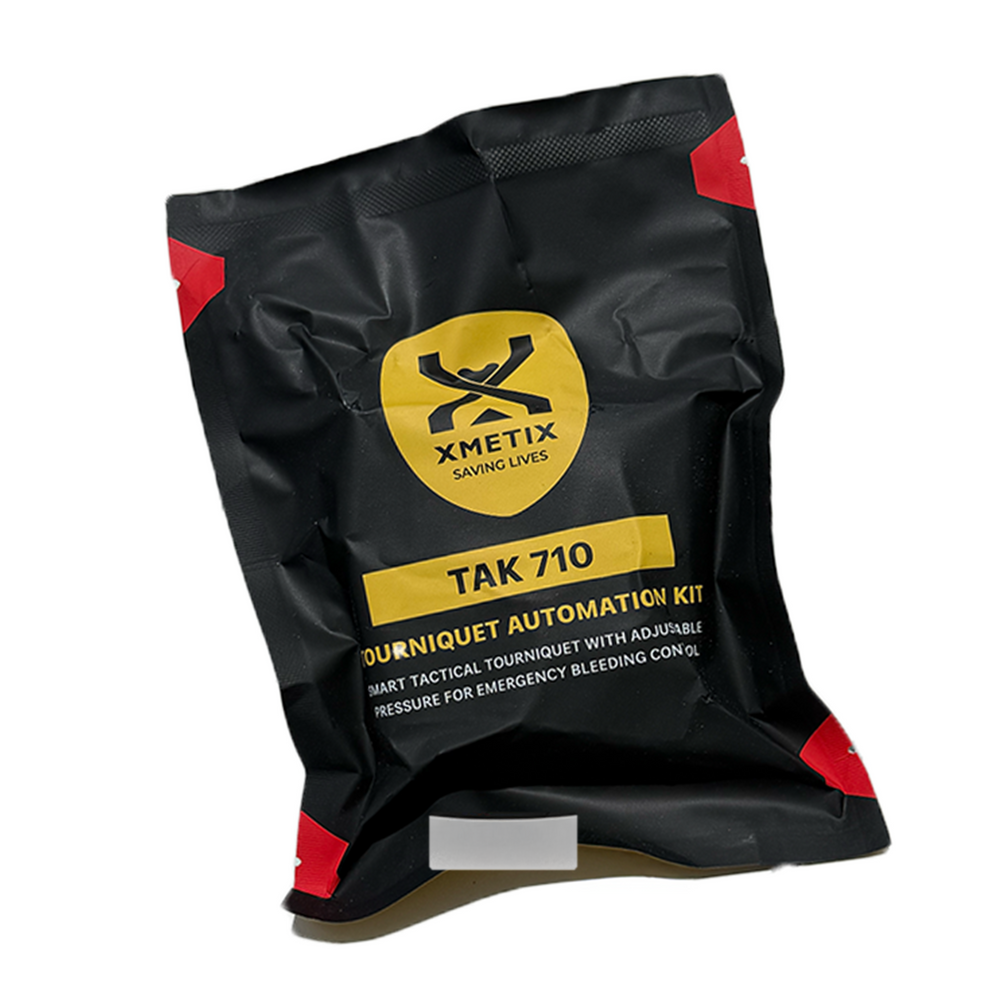
The TAK710 automatic tactical tourniquet eliminates this problem. After a single button press, the device tightens on the limb by itself and maintains the correct pressure. Operation does not require medical knowledge or paramedic training — just a few simple steps from the instructions.
| Criterion | Classic tourniquet | TAK710 automatic tourniquet |
|---|---|---|
| Requires medical training | Yes | No |
| Self-application with one hand | Difficult | Yes |
| Pressure | Depends on the user's strength and judgement — hard to estimate correctly | Automatic, constant (180–300 mmHg) |
| Risk of error under stress | High | Low |
How TAK710 works
Apply the band
To the limb — you can do it over clothing.
Remove the safety
Pull the safety pin out of the device.
Press the button
The device builds and maintains pressure on its own.
Application takes about 20 seconds — it can be done in the dark, under stress, with wet hands. The built-in timer shows the time since activation without manual recording, which speeds up handover to medics. Pressure can be fine-tuned with +/− buttons.
Technical data: weight approx. 180 g · up to 6 h operating time · temperature range −30 °C to +60 °C · IP56 rated · MIL-STD-810G standard · CE certified, FDA listed
See it in action
Manufacturer material (Xmetix) — field demonstration. Playback only on user request, no autoplay.
About us
AwaTak combines medical experience with frontline practice gained in Ukraine, including battlefield medicine and medevac operations. We bring TAK710 to Poland — technology we have verified ourselves as practitioners. We are a direct partner of Xmetix Ltd. and the exclusive importer of the device on the market.
Jakub Bałaban
President of AwaTak
Paramedic and graduate of the War Studies University. He gained experience in emergency medical teams and the Polish Medical Air Rescue. He also managed Airport Medical Rescue at Warsaw Chopin Airport.
Initiator and coordinator of Med Evacuation Poland, a medical group evacuating patients from Ukraine, medical director of the Humanosh Foundation and chairman of the Council of the Awangarda Foundation – Polish Medics on the Front Line. He has cooperated with the World Health Organization and European Union Civil Protection. In 2023 he was awarded the Silver Cross of Merit for medical assistance provided in war conditions.
Robert Pożoga
Vice-President of AwaTak
Combat medic and President of the Board of the Awangarda Foundation – Polish Medics on the Front Line. Since the beginning of the full-scale war in Ukraine he has organised medical aid, the work of rescue teams and the evacuation of the wounded and sick from areas affected by hostilities.
He commands a group of Polish medics operating directly in the frontline zone and is involved in creating a centre for rehabilitation, psychological support and prosthetics for Ukrainian veterans and civilian victims of the war. In 2023 he received the Medal for Sacrifice and Courage, and in 2025 the Silver Cross of Merit for humanitarian work.
Daniel Celiński
Managing Director of AwaTak
PhD in health sciences, paramedic and graduate of the Medical University of Warsaw. Since 2007 he has worked with the RM Meditrans ambulance service in Siedlce as a member of emergency medical teams, a dispatcher, auditor, medical simulation instructor and head of the Medical Rescue Education Centre.
He also gained experience in the Emergency Department of Praski Hospital and as a HEMS crew member of the Polish Medical Air Rescue. He currently works at the Department of Emergency Medical Services of the Medical University of Warsaw. In 2024 he received the Minister of Health's Blessed Gerard Award for implementing innovative solutions improving the quality of emergency medical services.
Ask about TAK710
Write or call us — we respond as quickly as possible.